Havelock – A Fleeting Fashion
By Grace Murphy, AmeriCorps Preservation Associate 2025-26
The havelock in the Beverly Heritage Center collection belonged to Hugh Patterson Boon. Mr. Boon enlisted with Company E 12th Pennsylvania Infantry on April 25, 1861 and mustered out on August 5, 1861. Two years later on September 1, 1863, he was commissioned as 1st Lieutenant of Company B, 1st West Virginia Cavalry, later becoming the captain. On April 6, 1865, he captured a flag at the Battle of Sailor’s Creek, the last major battle between the armies led by Generals Lee and Grant and the largest surrender of Confederate soldiers.1 Mr. Boon was awarded the Congressional Medal of Honor for this feat. This battle was a mere three days before Lee surrendered at Appomattox Courthouse. This havelock can be identified as belonging to Mr. Boon as “H. P. Boon. Comp E. 12th Reg. Pa. Vol.” has been written on the item.
(Soon, the havelock will be on display at the Beverly Heritage Center!)
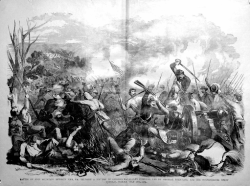
“BATTLE OF RICH MOUNTAIN. BEVERLY PIKE, VA.” Frank Leslie’s The Soldier in Our Civil War (1893). A soldier with his back to the viewer has donned a havelock in this depiction of the Battle of Rich Mountain.
Image source: https://archive.org/details/soldierinourcivi01lesl/page/n108/mode/1up
Havelocks, also known as neck curtains, originated with earlier theories which argued that heat-related illness originated with sun exposure to one’s head. (2) They were seen in the Western Virginian mountains very early on in the Civil War. Before infiltrating those mountains, however, they accompanied the British army in India. The garments were intended to protect British soldiers from the sun and heat. They were most closely associated with Major-General Sir Henry Havelock, hence the new name. (3) Over the course of the latter half of the 19th century, havelocks caught the eye of other nations preparing for military efforts in hot, tropical environs like France in Algeria and the United States in the Confederacy. Thanks to an 1857 English journal discussing British uniforms in India, havelock fever set in among Union aid societies. (4)
Havelock fever was a decidedly northern phenomenon. This was one of the many differences between Northern and Southern aid societies, groups that depended on the tireless effort of women regardless of region. In the North, these societies were marked by the legacy of the Second Great Awakening (1795-1835). This wave of religious revivalism ignited a great passion for moral reform colored by religious evangelism, activated by women’s presumably higher morality. These feelings manifested in nursing work in the pre-war period with women like Dorothea Dix. Dix, like many contemporaneous middle class women, was inspired by Florence Nightingale’s work in the Crimean War to pursue nursing as a calling, not as a paid profession. Alternatively, Dr. Elizabeth Blackwell, the US’ first woman trained physician, envisioned women as trained and compensated nurses. Both were integral in guiding Northern aid efforts towards a more centrally-controlled system. In 1861, Dr. Blackwell founded the Women’s Central Association of Relief in New York City. Eventually, this group was designated as an auxiliary of the United States Sanitary Commission while Dix became Superintendent of Women Nurses, signaling an official endorsement of her approach to nursing.(5) The USSC allowed Northern aid to be more effective by better organizing and dispensing material, supplies, and service hours. (6) The South’s more conservative atmosphere, smaller industrial sector, and greater physical destruction during the war kept the region from achieving a similar status.
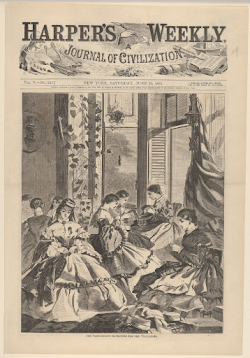
“THE WAR-MAKING HAVELOCKS FOR THE VOLUNTEERS,” Harper’s Weekly, June 29, 1861. This front page illustration by American artist Winslow Homer shows a group of women, possibly an aid society, making havelocks. The woman to the left of center wears one while the soldier’s portrait behind her is shrouded in shadows, likely portending an unfortunate future for the man pictured.
Image source: https://www.metmuseum.org/art/collection/search/348790
Northern aid societies were eager to supply the Union troops with havelocks to protect them from the heat of the South. This theory was sound on the surface, but in reality, the garments were a flop. Havelocks trapped heat and kept men from the slightest respite of a breeze as their necks and shoulders were shrouded in cotton or linen.(7) This discovery was made too late
to stem the avalanche of havelocks instigated by Northern aid givers at the war’s beginning. In the first month of the war, New York’s 69th Regiment received more than 1200 of the garments from a singular sewing circle; by the end of June 1861, students of a Massachusetts academy had completed 138; every Connecticut soldier mustered out with two at the war’s start with one company showered with six per man.(8) The garments are depicted in scenes of early battles such as Rich Mountain and Bull Run. Nevertheless, havelocks’ luck soon ran out. One source had it that by the time Connecticut’s 4th and 5th Regiments were organized, May and July 1861 respectively, men had taken to sticking leaves in their hatbands to achieve an effect similar to that intended by havelocks.(9) As it was, “An Englishman would melt in his boots before he would give up a custom enjoyed by his grandfather. Not so a Yankee.”(10) Havelocks were further maligned and repurposed.
Havelocks became the stuff of jokes. Troops jeered that the luckiest Union man was the one with the fewest relatives and therefore the fewest havelocks.(11) The style and oversupply gave Robert Henry Newell material for the misadventures of the Mackerel Brigade in his Orpheus C. Kerr Papers. Private Villiam Brown was variously mistaken as a “broomstick in a pillow-case” and a moonbeam while on his nightly sentry duties.(12) Likewise, an officer expressed concern for the global linen trade as his regiment received havelocks 80,000 at a time.(13) More practically, they were shirked by sharpshooters for being too flashy and likely to attract attention.(14) Charles E. Davis Jr. of the 13th Massachusetts Volunteers commended new official recommendations of repurposing havelocks as dish clothes and coffee strainers.(15) Havelocks were used for other purposes such as gun patches and bandages.
So it went, the cooling of havelock fever, a strange, largely forgotten, material culture anecdote rooted in colonialism, war logistics, work of women, and medical science.
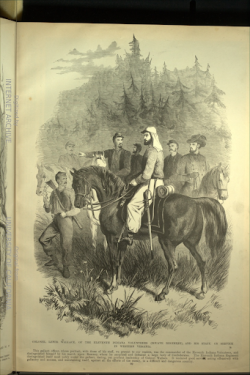
“COLONEL LEWIS WALLACE OF THE ELEVENTH INDIANA VOLUNTEERS (ZOUAVE REGIMENT),” Frank Leslie’s Illustrated History of the Civil War. This depiction of General Lewis Wallace, later known for his authorship of Ben-Hur: A Tale of Christ, includes two of the most unique garments of the Civil War – the havelock and the Zouave uniform. Zouaves were a military tradition stemming from French colonization efforts in North Africa during the 1830s. Roughly between 1859 and 1863, French forces became interested in and adopted the havelock for use in the region.(16)
Image source:
https://archive.org/details/importantevents00franrich/page/99/mode/1up?q=wallace
References
1 Patrick Schroeder, “Sailor’s Creek, Battles Of,” Encyclopedia Virginia, February 18, 2025, https://encyclopediavirginia.org/entries/sailors-creek-battles-of/.
2 E. T. Renbourn, “The Spine Pad: A Discarded Item of Tropical Clothing,” Journal of the Royal Army Medical Corps 102, no. 3 (1956): 217-218, https://web.archive.org/web/20200709035321id_/https://militaryhealth.bmj.com/content/jramc/102/4/217.full.pdf.
3 Renbourn, “The Spine Pad,” 219.
4 W. A. Croffut and John M. Morris, The Military and Civil History of Connecticut During the War of 1861-65 Comprising A Detailed Account of the Various Regiments and Batteries (Ledyard Bill, 1868), 65, http://www.8cv.org/references/croffut-and-morris.pdf.
5 Judith Ann Geisberg, Civil War Sisterhood: The U.S. Sanitary Commission and Women’s Politics in Transition (Northeastern University Press, 2000), 42-44, https://archive.org/details/civilwarsisterho0000gies/mode/2up.
6 Geisberg, Civil War Sisterhood, 47.
7 Charles E. Davis, Jr., Three Years in the Army: The Story of the Thirteenth Massachusetts Volunteers from July 16, 1861, to August 1, 1864 (Estes and Lauriat, 1894), 7, https://antietaminstitute.org/hrc/files/original/05b2e7251bed12e7c0f3c38c65cb004034ef5232.pdf.
8 Mary Elizabeth Massey, Women in the Civil War (University of Nebraska Press, 1994), 32; Croffut and Morris, The Military and Civil History, 65.
9 Croffut and Morris, The Military and Civil History, 148.
10 Davis, Three Years in the Army, 7.
11 Massey, Women in the Civil War, 32.
12 Robert H. Newell, The Orpheus C. Kerr Papers (Blakeman & Mason, 1862), https://www.gutenberg.org/files/35906/35906-h/35906-h.htm.
13 Newell, Orpheus C. Kerr.
14 “Colonel Berdan and His Sharpshooters,” Harper’s Weekly, August 24, 1861, http://www.sonofthesouth.net/leefoundation/civil-war/1861/august/berdans-sharpshooters.htm.
15 Davis, Three Years in the Army, 7.
16 Renbourn, “The Spine Pad,” 219.