“Building Beverly, Building the Nation” Exhibit Flags

“The English” panel features the 1606 Union flag. This flag is formed by laying the red St. George’s Cross on a white background on top of St. Andrew’s Cross on the navy blue background. St. George is the patron saint of England. St. Andrew is the patron saint of Scotland. This flag was created after the Union of the Crowns, when King James VI of Scotland ascended to the throne of England and Ireland, becoming James I of England.

This is the modern flag of the country of Guinea. It consists of three vertical stripes of red, yellow, and green, the Pan-African colors adopted from the flag of Ethiopia, a country that has remained independent despite imperial colonization of much of the African continent. This Guinean flag was adopted in 1958.
Beverly Heritage Note: This flag was chosen to represent a country that Rose may have been from. Our research so far cannot confirm what she may have called her homeland as an African woman kidnapped and enslaved. The modern nation of Guinea is just one nation with the word Guinea in it, and it is possible she was from a place now within the borders of Guinea-Bissau or Equatorial Guinea, two other African nations. As the 1747 map on this panel shows, Guinea was applied to a large portion of West Africa. We chose to represent the flag of Guinea in the exhibit as the records we have mention her as coming from “Guinea.“
The flag of Guinea-Bissau, adopted 1973:

The flag of Equatorial Guinea, current version adopted in 1979:


This is the Banner of the Holy Roman Emperor, used from 1430 to 1806. This black, double headed “Imperial” eagle, with halos, represented the Holy Roman Empire. The Empire was formally dissolved after Napoleon Bonaparte created of the Confederation of the Rhine from German states that pledged loyalty to the French.
Beverly Heritage Note: This flag was chosen as many German-speaking immigrants to North America would have come from regions within the Holy Roman Empire’s borders.
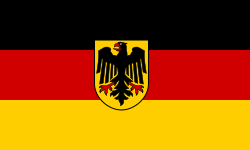
While not exact, this above eagle design is similar to the current State flag of Germany, adopted 1950. This flag has the horizontal stripes of the national flag of Germany, but add the coat of arms. This flag may only be used or flown by the central German government:

This is an unofficial Ulster Scots flag, laying the Red Hand of Ulster within a thistle on the St. Andrew’s Cross. These elements combine a heraldic symbol predating English colonization with two symbols of the Scottish people who arrived as part of the colonial workforce in the North of Ireland.
The Red Hand of Ulster has mythic origins. One version begins with a race to lay claim to the lands of Ulster–whoever lay their hand on the land first would reign. Two men were racing in boats to reach the border, and one man cut his hand off and tossed it to shore to ensure his win.
Beverly Heritage Note: Northern Ireland, as part of the United Kingdom of Great Britain and Northern Ireland, has no official flag. The flag above was chosen to represent the historic community that many Appalachians feel connected to, recognizing the complications of identities born through colonization.
Saint Patrick’s Cross is a symbol sometimes used to represent Northern Ireland on its own, and was added to the 1606 Union Flag above to create the modern Union Jack. Saint Patrick’s Cross:

This is the flag of the Province of Ulster, a region that encompasses land in both the Republic of Ireland and Northern Ireland. This is sometimes referred to as the Nine Counties Flag.

This is the Ulster Banner, with the Tudor Crown, the first of two versions used as the flag of the Government of Northern Ireland. Used 1924-1953.

This Ulster Banner was used as flag of the Government of Northern Ireland from 1953 to 1973 when the United Kingdom abolished it.


This is the flag of Cornwall, or Saint Piran’s Flag. Saint Piran is the Cornish patron Saint.

This is the Baner Cymru, or Welsh national flag, also called Y Ddraig Goch, or “the red dragon” in English. This version was officially adopted in 1959.
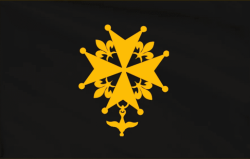
The Huguenot Cross is found in many colors and forms, often not as a flag. It is a symbol for many French Protestants and their descendants.