A Scotsman By Any Other Name…?
Article & photos by Grace Murphy, Beverly Heritage Center AmeriCorps (2025-26)
Any inquiry into Appalachian culture will turn up prolific references to the “Scotch-Irish,” a group which occupies a distinct place in the history of Ireland, Scotland, and America. The Scotch-Irish, also known today as “Scots-Irish,” were the largest emigrant group from Ireland to the American colonies from the mid-16th century to the 1770s. Many of the Scotch-Irish were dauntless frontierspeople who tossed their lot in with American Independence with distinction. But what to call this group? Scotch-Irish or Scots-Irish? This group and their evolving demonym reveals converging themes of Old and New World colonialism, transatlantic desires for freedom, and class.
The Scotch and the Irish
Before the Scotch-Irish could get to American shores, the Scots had to get to Ireland. In the early 17th century, this was done via the Ulster Plantation. This was a plan to “civilize” Ireland and further extract wealth for the British royalty and merchant class. It was begun in 1609-10 under King James VI and I (that’s one title for Scotland and one for England, respectively).* [1] In the years just prior to the establishment of the Plantation, the English crown had acquired lands in many of the counties of the Ulster province in Ireland.[2] These lands in hand, the installation of lairds (Scots for “lords”) in Ulster could begin. But what is Ulster, anyway?
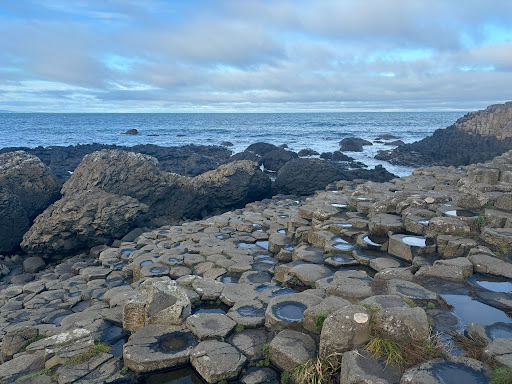
Ulster is one of the modern four provinces of Ireland. Historically, these provinces correlated with kingdoms and may have included a fifth that is no longer used. Ulster includes the counties of Antrim, Armagh, Cavan, Donegal, Down, Fermanagh, Londonderry, Monaghan, and Tyrone.** Ulster is sometimes incorrectly used interchangeably with the term “Northern Ireland,” that part of the island that is still part of the United Kingdom. Only 6 of Ulster’s 9 counties are encompassed by the entity Northern Ireland. Laying close to the modern country of Scotland, the northeastern Ulster coast shares deep Celtic/Gaelic history with the Scots. The Celtic kingdom of Dál Riata reached from Ireland’s northeast coast to Scotland’s western reaches. Folklore tells us that Giant’s Causeway, the UNESCO heritage site located off the Antrim coast noted for its geometric basalt columns, was formed when the Irish giant Fionn mac Cumhaill (Finn MacCool) threw stones to cross the Irish Sea to face a Scottish giant, Benandonner. Giant’s Causeway and the Scottish Fingal’s Cave are the paired remnants of this face-off. [3] Seeing as the plantation was meant to corral Ireland’s wilderness and wildness, it is clear that not all Scotsmen were to be welcomed.
The Plantation operated on a system where undertakers (who were to “undertake” the job of establishing British settlers in Ulster), and to a lesser degree servitors (servants of the Crown in military or government capacities), were given acreage to be worked by tenants. [4] Only Scotsmen from the Lowland, “inward parts of Scotland” were given land as undertakers. [5] No similar restrictions were imposed on English participants. Still, the Scottish undertakers outnumbered the English ones at the scheme’s start with their lands worked by tenants who generally came from similar locales as themselves. [6] Of course, the best laid plans don’t always remain so. Outlaws from the region of the Anglo-Scottish border sought refuge in Ulster and the native Irish, whose presence was to be crushed by the Plantation, came to play their role in the tenantry.[7] A large portion of the tenants were Scottish Presbyterians. This community have been derided historically as degenerates whom Britain was glad to get rid of, but who were religious people now navigating life and religious obligations in a rural, unfamiliar region.[8] This characterization could be equally applied to their new lives in the American colonies.
Left: Giant’s Causeway, an important Irish-Scottish Gaelic folklore site.
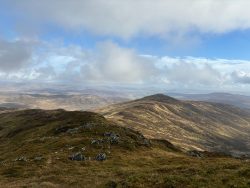
Right: Views around Ben Vrackie, a peak in Pitlochry, a Scottish Lowland-Highland border town.
Scotch-Irish in the American Colonies
Like so many other emigrants, the Scotch-Irish were motivated to cross the Atlantic by religious and economic frustrations. A series of famines and embargoes placed on imports from Ireland to England were scattered across the mid 17th and very early 18th centuries. Scotch-Irish emigration reached a sustained level in 1718 when rents became intolerable, especially when paired with obligatory Anglican tithes demanded of tenants and after many years of a strangled Irish textile industry.[9] Reoccurring hard times in the 1740s and ‘70s further propelled Pre-Revolution emigration.[10] From the start, the Scotch-Irish were noted for their ability to defend colonial frontiers, being a most willing group to man forts, providing community and manpower. The Scotch-Irish frontier ability and previously forged distaste for the English made for enthusiastic fighters in the cause of American Independence.
These Scotch-Irish were largely Presbyterians. The oldest Scotch-Irish congregations found in the trans-Allegheny congregations date from 1771. One Scotch-Irish Presbyterian minister and Augusta County, Virginia native, Samuel Doak, is remembered today for his commitment to education (a calling card of the Scottish Presbyterians in both the Old and New Worlds) and his rousing sermon to mountaineer Patriots before the Battle of Kings Mountain (SC) in 1780.[11] Closer to home in Randolph County, the historical record is rife with connections to the church. According to one source, the county’s first religious service was held in 1786 by Presbyterian Rev. Edward Crawford (a Scottish last name) who came from the Valley of Virginia.[12] Even Charleston, WV has Scotch-Irish ties. It was named by George Clendinen–an Ulster emigrant and frontier politician and landman in the Kanawha Valley–for his father who died there in 1790.[13] Indeed, it is clear the Scotch-Irish have left their mark on their adopted homelands, but what are they properly called?
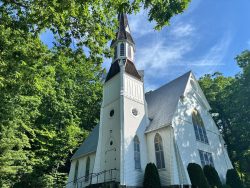
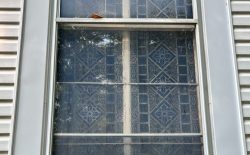
Left: Tygarts Valley Presbyterian Church, Huttonsville, WV. Built in 1883, the congregation dates to 1772.
Right: Scottish thistle stained glass window, Tygarts Valley Presbyterian Church.
A Scotsman by Any Other Name…?
There is a great debate over the terms “Scots-Irish” and “Scotch-Irish.” “Scots” is a common self-referential term used by Scottish people, as in Scotsman. There is some serious etymology at play here. Historical self-referential terms used in Scotland include Scottish and Scottis. Scottish is the earliest English form, found as early as 900. Scottis is a Gaelic word that has many different definitions such as the language spoken by Gaelic Scots or the people themselves.[14] Scottish likely shortened into Scotch while Scottis became Scots. “Scotch” came about at a time when there was a reasonable amount of Anglo-Scottish harmony. Its clout declined as Scottish desire for home rule and preservation of a distinct Scottish cultural identity increased in the late 19th century.[15] This desire was in large part homegrown in Scotland, but was also fostered by responses to contemporary Irish agitations for Home Rule which threatened to split the Atlantic Archipelago into a binary – Britain and Ireland. [16] A switch to “Scots” in this era was partially inspired by the want to preserve a Scottish identity as this threat loomed. These terms further evolved in the colonies and the eventual United States.
Today, “Scotch-/Scots-Irish” often refers to non-Catholic Irish communities, rather than its historical connotation with Scottish Presbyterianism specifically. This is thanks in part to changing assumptions of Irishness on both sides of the Atlantic. In the 1790s, America’s first political parties were congealing in the young Republic. The Federalists were associated with the gentility, their ranks populated by lawyers and bankers. At the other end were the Democratic-Republicans, the populist party. Here now, the term “Scotch-Irish” reemerged from its American Revolution-era obscurity.[17] It was then used by Protestant Irish individuals and their descendants to endear themselves to the gentility. To identify as “Scotch-Irish” was to identify with Hamiltonian politics, the Federalists, and the middle class. It separated oneself from the Catholic “wild Irish” who went in for populism across the aisle.[18] Later, in the mid-19th century, Irish national identity was drawing even closer to Catholicism.
Irish Catholic Parliamentarian Daniel O’Connell’s steadfastness in securing Catholic emancipation and his oratorical abilities were key ingredients in making “Catholic” synonymous with “Irish”.[19] The end result was that “Scotch-Irish” became shorthand for all Protestants in the Irish ethnic community, especially among conservatives who wished to differentiate themselves from growing Catholic nationalism in Ireland. These feelings were heightened by an Gorta Mór.
An Gorta Mór is the Gaeilge (that is Irish) term for the Great Hunger (1845-1852). The causes for this event are many varied and much debated. At a minimum, it can be said that the potato crops that native Irish populations grew to depend on were wiped out by a blight.*** This devastation was multiplied by a variety of importation/exportation and private property laws imposed on Ireland by England, further diminishing any food base the Irish could have accessed. These factors plus England’s general laissez faire policies created a dire situation. Definite numbers are difficult to determine, but estimates state that the Irish population fell by 3 million due to the Hunger. One to 1.5 million Irish perished and 1.5 to 2 million left, many headed to the United States. These emigrants were markedly different from the Scots-Irish – hailing from western counties where the Irish language had remained in everyday use. Additionally, they were generally poorer and Catholic.[20] The presence of these refugees and 19th century bigotry further encouraged middle-class Protestant Irish adoption of the title, “Scotch-Irish” By the end of the 19th century, “Scotch-Irish” was completely severed of its Presbyterian roots and more than ever signaled middle classhood.
Conclusion
The Scotch-/Scots-Irish identity occupies a very particular place in the histories of America and the Atlantic Archipelago. The terms are used by historians and descendents alike to refer to people who came to the American colonies via Scotland and the Ulster province. In time, it lost its Presbyterian roots and was adapted as a signifier for non-Catholic Irish with middle class aspirations. The Scotch versus Scots debate tells us much about evolving national identities in the turbulent late 19th and early 20th centuries as England’s closest neighbors reckoned with their relationships to one of the world’s largest empires. In the end, this identity is celebrated with much pride in regions like Appalachia when ancestral feats of strength are performed or when stories of frontiersmanship are shared.
Notes
*The Acts of Union 1707 united the English and Scottish parliaments into one entity known as “Great Britain,” with a common Monarch. The Acts of Union of 1800 and 1801 abolished the Irish parliament.
**The Irish names for these counties are Aontroim, Ard Mhacha, Dún na nGall, An Dún, Fear Manach, Doire (London was of course added to the transliteration of this word by the English), Muineachán, and Tir Eoghain.
***The rocky lands of western Ireland have poorer soil, where few crops beside the potato can grow fruitfully. It was to these lands the native Irish were forced to by the Ulster Plantation and later colonization attempts such as the invasion lead by Oliver Cromwell (1649-1653).
References
1 Henry Jones Ford, Scotch-Irish in America (Princeton, NJ: Princeton University Press, 1915), 21.
2 Ford, Scotch-Irish in America, 16.
3 “Giant’s Causeway World Heritage Site,” Causeway Coast & Glens Heritage Trust, accessed May 26, 2026, https://ccght.org/giantscausewaywhs/.
4 “Plantation People.” Ulster Historical Foundation, accessed May 26, 2026, https://ulsterhistoricalfoundation.com/ulster-plantation/plantation-people.
5 Ford, Scotch-Irish in America, 555.
6 “Plantation People.”
7 Ford, Scotch-Irish in America, 101, 121-122.
8 Ford, Scotch-Irish in America, 104-106.
9 Ford, Scotch-Irish in America, 185-186.
10 Ford, Scotch-Irish in America, 198, 203.
11 Jeff Biggers, United States of Appalachia: How Southern Mountaineers Brought Independence, Culture and Enlightenment to America (Berkeley, CA: Shoemaker & Hoard, 2007), 74-75.
12 Hu Maxwell, The History of Randolph County, West Virginia: From Its Earliest Settlement to the Present, (Morgantown, WV; The Acme Publishing Company, 1898), 312.
13 John Edmund Stealey II, “George Clendinen and the Great Kanawha Valley Frontier: A Case Study of the Frontier Development of Virginia,” West Virginia History: A Quarterly Magazine XXVII, no. 4 (July 1966), 292.
14 Michael Montgomery, “Scotch-Irish or Scots-Irish: What’s in a Name?” The Ulster-Scots Language Society, accessed May 26, 2026, https://www.ulsterscotslanguage.com/en/texts/scotch-irish/scotch-irish-or-scots-irish/.
15 Michael Shaw, The Fin-de-Siècle Scottish Revival: Romance, Decadence and Celtic Identity, (Edinburgh: Edinburgh University Press, 2022), 10-11.
16 Shaw, The Fin-de-Siècle Scottish Revival, 12.
17 Donald Harman Akenson, The Irish Diaspora: A Primer, (Belfast: The Queen’s University of Belfast, 1993), 254.
18 Kerby A. Miller, Ireland and Irish America: Culture, Class, and Transatlantic Migration, (Dublin: Field Day, 2008), 135.
19 Akenson, The Irish and Irish America, 221.
20 Akenson, The Irish and Irish America, 236; Bryan L. Mulcahy, “Irish Immigration to the United States and Canada,” Lee County Library System, May 28, 2019, https://libraryaware.com/1159/NewsletterIssues/ViewIssue/03145c89-be50-4280-a019-f257cacedf84?postId=bf8b537a-ffe6-40ff-9af5-317b10ee9b2d.
Tags: America250, Scots-Irish